Nvidia, AI chips and the border: tariffs, RAM prices and the data center race in 2026
Nvidia lost a third of its value in seven weeks while selling more chips than ever. What happened, why the stock market moves with it, what the US tariff on AI chips covers, why memory costs four times more, and how to run AI at home.
By the Othermile team
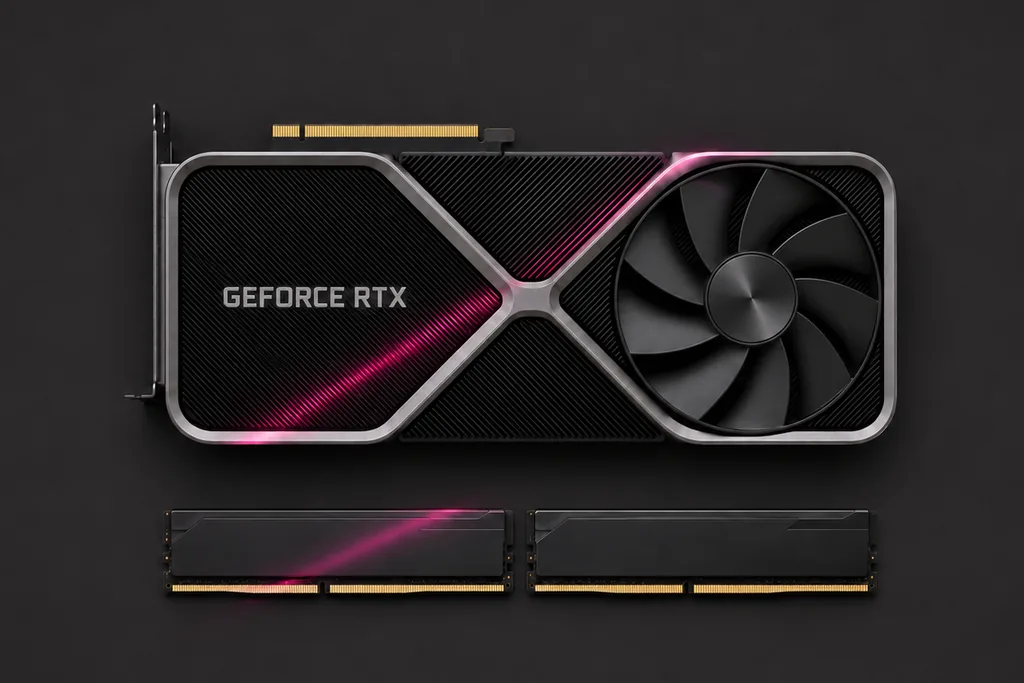
Nvidia sold $115.8 billion worth of chips in the three months to October 25, 2026, more than twice as much as a year earlier. Over the same seven weeks:
- its share price fell by about a third
- its founder Jensen Huang resigned and was back in charge 11 days later
- the S&P 500 fell in eight of nine trading days
Those facts sit side by side because so much of the world's AI spending, and so much of the stock market, now passes through one company.
The story in eight moments
Hover or tap a point to read what happened and where the shares stood that day. The full chart with every event is further down.
Points are evenly spaced, not to scale. Share changes are since the start of 2023, or since a company's first day of trading. For information only, not investment advice.
What this guide covers:
- what happened at Nvidia and why the whole market felt it
- what the US tariff on advanced AI chips covers when equipment crosses the border
- why the memory inside every computer costs about four times what it did a year ago
- where the biggest AI data centers are being built, including the plans to put them in orbit
- what Google, OpenAI, Anthropic and SpaceX are doing
- how to run capable AI on your own computer at home, with nothing sent to anyone
Figures are as of November 25, 2026, unless a line says otherwise. The share prices just below refresh while this page is open.
Share prices
Prices load when the page opens.
- S&P 500Index
- NvidiaNVDA
- AMDAMD
- IntelINTC
- SpaceXSPCX
- AnthropicANT
- OpenAIPrivateNo sharesLast valued at $852 billion, March 2026
Delayed prices with the change on the day before, refreshed while this page is open. The line under each is the last 30 trading days. For information only, not investment advice.
The short version
- Nvidia's sales keep setting records. It sold $115.8 billion last quarter, up 103% on a year earlier, and forecasts about $130 billion for the quarter ending in January. About 93% of it is chips for data centers.
- Its share price went the other way. Nvidia closed at a record on October 6, worth about $5.8 trillion. By November 24 it was worth about $3.7 trillion, after a fall that included a seven day drop of about 27% and its third best day on record.
- Your index fund owns a lot of it. Nvidia was about 7.6% of the S&P 500 at the start of November and about 5% three weeks later. Someone with $10,000 in an S&P 500 fund held about $760 of Nvidia at the start of the month without choosing to.
- Jensen Huang left and came back. He resigned on November 12 after reports about his personal relationships. The board reinstated him on November 23 and says its investigation continues.
- The US has charged 25% on certain advanced AI chips since January 15, 2026. Chips going into large US data centers, gaming and personal computers, research, startups, repairs, industry and government are exempt, so few buyers pay it.
- Into Canada, computers, graphics cards and chips pay no duty. The buyer pays GST or HST, and usually a courier's clearance fee.
- Memory has roughly quadrupled in price. Contract prices for ordinary memory chips rose 90 to 95% in the first quarter of 2026 alone. A chip that cost $100 in December 2025 costs about $400 by the end of 2026.
- The biggest AI data centers running today draw about 1 gigawatt each. Sites now planned go up to 8 gigawatts, and SpaceX has asked to launch up to a million satellites for computing in orbit.
- You can run a strong AI model at home. A gaming PC you already own handles small models. About $3,500 to $7,000 of hardware runs large ones, fully offline.
Why so much of the stock market moves with Nvidia
Almost every large AI model is trained and run on Nvidia's chips. The main exceptions are Google's own TPU chips and Amazon's Trainium chips, and even Google and Amazon rent Nvidia systems to their customers.
How much Nvidia changed: in early 2023, gaming graphics cards were about a third of its sales. Last quarter, chips for data centers were $107.6 billion of its $115.8 billion.
Nvidia's sales by quarter, in US dollars
Data center chips are nearly all of it now. The last bar is the company's own forecast for the quarter ending in January 2027.
- Data center
- Gaming, design, cars and the rest
- Forecast, about $130 billion
Show the numbers
| Quarter | Ended | Total | Data center |
|---|---|---|---|
| Q1 FY26 | Apr 2025 | $44.1 billion | $39.1 billion |
| Q2 FY26 | Jul 2025 | $46.7 billion | $41.1 billion |
| Q3 FY26 | Oct 2025 | $57.0 billion | $51.2 billion |
| Q4 FY26 | Jan 2026 | $68.1 billion | $62.3 billion |
| Q1 FY27 | Apr 2026 | $81.6 billion | $75.2 billion |
| Q2 FY27 | Jul 2026 | $96.2 billion | $89.0 billion |
| Q3 FY27 | Oct 2026 | $115.8 billion | $107.6 billion |
| Q4 FY27 | Jan 2027 | $130.0 billion (forecast) | Not forecast |
Nvidia's quarterly results releases, most recently November 17, 2026. Nvidia's fiscal year ends in late January; the quarter ending January 2027 has 14 weeks.
A short list of customers
The buyers are a handful of companies:
- Cloud companies that buy the chips and rent out computing: Microsoft, Google, Amazon, Meta and Oracle
- AI labs that rent that computing or build their own: OpenAI, Anthropic and Elon Musk's xAI, now part of SpaceX
When these few companies plan to spend more, Nvidia's forecast rises, and so do the companies selling into the same buildings:
- Chips: AMD and Broadcom
- Memory: Micron, SK Hynix and Samsung
- Power: the utilities and turbine makers that supply the electricity
When they hesitate, all of them fall together.
Why your retirement account is involved
Index funds make this everyone's business. A fund that follows the S&P 500 holds each company in proportion to its value.
At the start of November, Nvidia was the second largest company in the index after Apple. Add Microsoft, Alphabet, Amazon, Meta and Broadcom, whose plans depend on the same AI spending, and a large share of a typical retirement account now depends on whether that spending keeps growing.
The money moves in a circle
- Nvidia to OpenAI: Nvidia put $30 billion into OpenAI's funding round in March.
- Nvidia backs OpenAI's buildings: in August, Nvidia agreed to back the land, power and buildings of a campus in Pike County, Ohio, where OpenAI will rent Nvidia computing on 20 year leases. Nvidia's own quarterly filing caps those guarantees at $105 billion, and says that if OpenAI cannot pay, Nvidia may take over the leases.
- AMD to OpenAI: AMD gave OpenAI the right to buy up to about 10% of AMD as part of a chip deal.
- Anthropic to the cloud companies: Anthropic has committed at least $114.5 billion to Google Cloud, $110 billion to Amazon and $44.9 billion to Microsoft, according to reporting on its listing documents.
Each deal is real business. Together they mean that trouble at one AI lab reaches its suppliers, their investors and the index funds that hold all of them.
What the AI giants are worth
Nvidia's value fell by about $2 trillion in seven weeks. That one drop is larger than OpenAI and Anthropic's last private valuations put together.
Nvidia: market value at each close. SpaceX: its listing on Nasdaq. Anthropic and OpenAI: their announced funding rounds; Anthropic listed on Nasdaq on November 19, 2026, and its price is in the strip above.
Three years of AI news, next to the share prices
The chart lines up the news with the prices.
- Nvidia is the green line and the S&P 500 the dark one; add AMD, Intel, SpaceX or Anthropic to compare.
- The lines show the change in price since the start of the period you pick, so a company that went public in June starts from zero on its first day of trading.
- Tap or hover over a dot to read the news from that day.
Three years of AI news next to the share prices
Each dot is a moment that moved the market. Pick the lines to compare, then hover or tap a dot to read what happened. Lines show the change in price since the start of the period, so a company worth $100 and one worth $1,000 can share a scale.
The chart loads when the page opens. Every event is listed below.
Every event, newest first
- The selloff deepensWorries about AI spending, new US tariffs on China and a likely rate rise sent the Nasdaq down about 4% during the day.
- Huang returnsThe board reinstated Huang, saying it was satisfied with his candor; its investigation continues. Nvidia rose 31% that day.
- Anthropic lists on NasdaqAnthropic started trading as ANT after the largest share sale on record, about $81 billion at $83 a share. It opened at $111.50.
- A record quarter anywayNvidia reported $115.8 billion in quarterly sales, up 103% on a year earlier, and forecast $130 billion next quarter. The shares kept falling.
- Jensen Huang resignsHuang stepped down as chief executive after reports about his personal relationships, including one the board said it was investigating as a possible foreign intelligence effort. Finance chief Colette Kress became interim chief executive.
- Altman on your RAMSam Altman said it is "quite terrible" that so much of the world's scarce memory sits in personal computers, used about 5% of the time.
- The peakNvidia closed at a record, worth about $5.8 trillion. AMD peaked the same day.
- Gemini 4 ArgonGoogle released Gemini 4 Argon, which it called its most capable model, and followed it with more Gemini 4 models in November.
- 8 gigawatts in OhioNvidia backed SB Energy's campus in Pike County, Ohio, where OpenAI will rent 8 gigawatts of Nvidia computing on a 20 year lease.
- SpaceX lists on NasdaqSpaceX started trading as SPCX after raising about $75 billion at $135 a share. It closed its first day near $161.
- Anthropic passes OpenAIAnthropic raised $65 billion at a $965 billion valuation, above OpenAI's.
- OpenAI raises $122 billionOpenAI closed the largest private funding round on record, valuing it at $852 billion. Nvidia put in $30 billion.
- SpaceX buys xAISpaceX took over Elon Musk's AI company xAI in a share deal valuing the two at $1.25 trillion, and pitched data centers in orbit.
- US tariff on AI chipsA 25% US tariff started on certain advanced AI chips and the servers that carry them, with exemptions for chips going to US data centers.
- Worth $5 trillionNvidia became the first company valued at $5 trillion.
- OpenAI picks AMD tooOpenAI agreed to use 6 gigawatts of AMD chips and received the right to buy up to about 10% of AMD. AMD rose about 24% in a day.
- The $100 billion letterNvidia said it would invest up to $100 billion in OpenAI as OpenAI built 10 gigawatts of Nvidia systems. The deal was later reshaped.
- Worth $4 trillionNvidia became the first company valued at $4 trillion.
- China sales blockedThe US required a licence to sell Nvidia's H20 chips to China. Nvidia expected a $5.5 billion charge.
- Tariff shockThe US announced tariffs on almost every trading partner. The S&P 500 had its worst two days since 2020, and Nvidia fell further.
- DeepSeek dayA Chinese lab showed a strong model trained on far fewer chips. Nvidia fell 17%, the largest one day loss of value for any company until then.
- Worth $3 trillionNvidia closed above $3 trillion, and two weeks later was briefly the most valuable company in the world.
- Blackwell unveiledJensen Huang showed the Blackwell chips that would power the next two years of AI data centers.
- Worth $2 trillionNine months after $1 trillion, Nvidia briefly passed $2 trillion.
- Worth $1 trillionNvidia briefly became the first chip company valued at $1 trillion.
- Nvidia's forecast shocks Wall StreetNvidia forecast sales about 50% above what analysts expected, and its shares rose about 24% in a day. Many investors date the AI boom in stocks from this day.
Daily closing prices, delayed, with weekly closes before the last 400 days. Events from company filings and announcements and from CNN, CNBC, Reuters and Bloomberg reporting.
What stands out:
- The first jump came on May 25, 2023, when Nvidia's forecast came in about 50% above what analysts expected.
- The climb: nine months to go from $1 trillion to $2 trillion, then about 20 months more to reach $5 trillion in October 2025.
- The big falls came from outside Nvidia's own results: a Chinese lab showing a cheaper way to train models in January 2025, US tariffs in April 2025, limits on sales to China, and in November 2026 a mix of leadership turmoil, new tariffs, a likely rise in interest rates and doubts about whether AI spending can keep growing this fast.
- Intel's line tells its own story. The US government took a stake of about 10% in the company in August 2025, Nvidia invested $5 billion a month later, and Intel's shares reached about $141 in June 2026 before falling back to about $50 in late November.
Seven weeks that cut Nvidia's value by a third
October 6 was the high point. Nvidia closed at a record, worth about $5.8 trillion, and AMD peaked the same day. What followed:
- November 8. Huang admitted to an extramarital affair and apologized to his family and colleagues. The board said it was investigating reports that he had been the target of a foreign intelligence effort, and at first said it had no reason to believe national security or company secrets had been compromised.
- November 12. After a further report of an affair with an executive who reported to him, Huang resigned as chief executive and left the board. Colette Kress, the finance chief since 2013, became interim chief executive, and Harvey Jones became the board's first chair. The shares fell more than 10% before the market opened.
- November 17. Nvidia reported its best quarter ever and forecast a bigger one. The shares kept falling.
- November 19. Anthropic began trading on Nasdaq after raising about $81 billion, the largest share sale on record. It opened at $111.50, well above its $83 offer price.
- November 20. Nvidia ended a seven day stretch down about 27%. At its lowest it was nearly half below its October high.
- November 23. The board reinstated Huang, saying it was satisfied with his candor and had heard from senior US officials that his return posed no national security risk. Its investigation continues. Nvidia rose 31%, its third best day on record, and the S&P 500 rose 4.7%.
- November 24 and 25. The gains faded and Anthropic closed below its offer price. On November 25 the Nasdaq fell about 4% during the day, after an inflation report made a December rate rise look almost certain and new US tariffs on China renewed fears of a trade war. South Korea's main index, heavy with the memory makers Samsung and SK Hynix, fell 6.2% that day and is down 48% from its June peak.
None of this changed what Nvidia sells or how fast it sells it. The worries reported in the market are about next year:
- whether the AI labs can keep raising the money to pay for the computing they have ordered
- how much governments will regulate
- whether companies valued at more than $1 trillion can grow into those values
The US tariff on advanced AI chips, and what crosses the border
On January 15, 2026, the US started charging an extra 25% on some imported AI chips under Section 232, the law that lets the President set tariffs for national security. It applies to goods from every country, and the US tariff schedule lists it as heading 9903.79.01.
What it covers
It covers far less than the headlines suggested. A product pays it only when all three are true:
- It is classified as a computer, a computer unit or a computer part (tariff codes 8471.50, 8471.80 and 8473.30).
- It contains a logic chip.
- That chip falls inside one of two narrow performance bands set by its processing power and memory speed. Law firms reviewing the order named Nvidia's H200 and AMD's MI325X as examples.
Who does not pay it
Even then, it does not apply when the chips are for:
- a US data center that adds more than 100 megawatts of new power for AI
- repairs or replacements done in the US
- research and development in the US
- a startup (a US "emerging growth company")
- consumer electronics such as gaming PCs, workstations and cars
- industrial uses such as factory robots
- US government use
Whether a shipment pays depends on the chip's datasheet and on what the buyer will use it for, and a tariff code cannot tell either. So Othermile's border checker names this tariff on every estimate for those codes, without adding it to the total, and says why.
The tariffs most buyers actually pay
Other tariffs matter more for most people buying computer equipment. These are estimates for US$10,000 of each item shipped by air, from Othermile's border engine on the rules in force on November 25, 2026, for a business import with no trade agreement claim:
| Item | US tariff code | Made in China, into the US | Made in Taiwan, into the US | Into Canada, any origin |
|---|---|---|---|---|
| Graphics card or AI accelerator board | 8473.30.1180 | 25% | none | No duty; GST or HST |
| Server | 8471.50.0150 | 25% | none | No duty; GST or HST |
| Processor chips | 8542.31.0000 | 50% | none | No duty; GST or HST |
| Network switch | 8517.62.0090 | 7.5% | none | No duty; GST or HST |
| Router | 8517.62.0010 | 25% | none | No duty; GST or HST |
| Power supply | 8504.40.9580 | 37.5% | 10% | No duty; GST or HST |
Notes on the table:
- The percentages leave out the US customs processing fee (0.3464% of the value on a formal entry, between $34.58 and $670.86) and the courier's own fees.
- Computers and chips are among the products left out of Taiwan's 10% US country tariff; power supplies are not.
- Goods made in Mexico or Canada can enter the US with no tariff when the paperwork includes a CUSMA claim, a statement that the item qualifies as made in North America.
Two things to know before you price computer equipment
- Use the full 10 digit code. The US lists several of its China tariffs at 8 or 10 digits, so a 6 digit code such as 8473.30 can cover products that pay 25% and products that pay nothing. Othermile's checker warns when a short code covers products on a tariff list.
- One product, one China list. Network equipment under 8517.62 pays either the 25% list or the 7.5% list depending on its 10 digit code, never both. The lists name the exceptions in words ("except for such machines provided for in statistical reporting number 8517.62.0090"), which is easy to misread.
RAM prices, and what Sam Altman said about the memory in your computer
Why memory ran short
- What it is: memory chips, called DRAM, hold what a computer, phone or server is working on.
- The conflict: AI data centers need a stacked kind called high bandwidth memory, made by the same three companies (Samsung, SK Hynix and Micron) on the same production lines.
- The result: as those companies moved lines to the more profitable AI memory, ordinary memory ran short.
In October 2025, OpenAI signed letters of intent with Samsung and SK Hynix for up to 900,000 memory wafers a month for its Stargate data centers. Analysts at the time estimated that would be close to 40% of the world's output.
The figure has since been described as a target for later in the decade rather than a monthly order today. Prices rose anyway.
What it did to prices in shops
- Nvidia DGX Spark, a desktop AI computer with 128 GB of memory: launched at $3,999, listed at $6,950 since October 2, 2026, with Nvidia naming memory supply as the reason.
- RTX 5090 graphics card: lists at $1,999, sold for $3,500 to $5,000 at US retailers in October.
- Small AMD computers with 128 GB of memory: from about $2,000 to about $3,500.
- Apple raised Mac prices in June and named memory costs.
What Sam Altman actually said
Late in October, Sam Altman, OpenAI's chief executive, said on the Cheeky Pint podcast with Stripe cofounder John Collison:
"quite terrible to have everybody have a bunch of the world's limited supply of DRAM sitting in their own computer, and being used five percent of the time."
- His point: AI runs more efficiently in shared data centers than on personal machines. He was replying to a suggestion that free models people run at home would cut the demand for data center memory.
- What he did not say: that anyone should give up the memory in their computer. He also gave no source for the 5% figure.
How it landed: badly, with people paying several times last year's price for the same memory. Critics pointed out that OpenAI sells access to models that run in its own data centers.
Both points can be true at once.
- Shared servers can keep memory busier than a home computer does.
- The people who own the servers decide what that memory is used for and what it costs you.
Running models on your own machine keeps that decision with you, which is where this guide ends.
The biggest AI data centers on the ground
An AI data center is measured by the electricity it draws, because the chips and their cooling use most of it. One gigawatt is roughly what 750,000 homes use.
The biggest AI data centers, by electric power
One gigawatt (GW) is roughly what 750,000 homes use. The largest sites running today draw about one; the largest planned ones are up to eight times that.
Running now
Announced or being built
Running now: Epoch AI's estimates of the power going to computers at each site, November 2026. Planned: the capacity each company announced. The Alberta site is a proposal facing a court challenge.
In the US
- Project Rainier, Indiana. Amazon's campus for Anthropic, built on Amazon's own Trainium chips, is the largest AI site running today by Epoch AI's estimate, at just over 1 gigawatt.
- Colossus 2, near Memphis. xAI's second supercomputer runs mostly on gas turbines on site and is planned to grow toward about 1.5 gigawatts.
- Stargate, Abilene, Texas. OpenAI and Oracle's first Stargate campus, planned for about 1.2 gigawatts across eight buildings. The wider Stargate plan with SoftBank and Oracle aims at about 10 gigawatts across the US.
- Fairwater, Wisconsin and Atlanta. Microsoft's two largest AI sites. Epoch AI expects the Wisconsin site to pass 2 gigawatts by 2028.
- Hyperion, Louisiana. Meta said in July 2026 that Hyperion will grow to 5 gigawatts.
- Pike County, Ohio. The campus Nvidia is backing for OpenAI: 4.25 gigawatts at first, with an option for 3.75 more, for 8 in all.
In Canada
- Bell's AI Fabric, Saskatchewan: could reach 1.2 gigawatts, with up to $52.5 billion of investment, according to the federal government.
- Telus: building AI centers that will hold more than 60,000 Nvidia GPUs.
- Wonder Valley, Alberta: Kevin O'Leary's proposed site would reach 7.5 gigawatts. The Sturgeon Lake Cree Nation has taken the province to court over its decision to skip an environmental assessment.
Sam Altman has said OpenAI is looking at about $1.4 trillion of computing commitments over eight years. Whether all of it gets built depends on whether the AI labs keep finding the money, which is the question the stock market is asking now.
Data centers in space
On January 30, 2026, SpaceX asked the US Federal Communications Commission for permission to launch and run up to one million satellites as a "SpaceX Orbital Data Center System".
- The filing says launching a million tonnes of satellites a year could add 100 gigawatts of AI computing.
- Elon Musk has said that putting AI in space is the only way to keep scaling it, and that computing in orbit could work within two to three years.
Why orbit appeals:
- in the right orbit the sun shines almost all the time
- there are no neighbors, permits or power lines
Why it is hard:
- Heat. In a vacuum there is no air to carry heat away, so every watt the chips use has to be radiated from large panels.
- Cost. Every kilogram of those panels has to be launched.
Two companies are testing smaller versions:
- Starcloud launched a satellite carrying an Nvidia H100 in late 2025, raised $170 million in March 2026, and signed a contract with SpaceX to fit Starlink laser links to its next 25 satellites.
- Google's Project Suncatcher plans two prototype satellites with Google's TPU chips by early 2027, with the satellite company Planet. Google's own paper says launch costs would need to fall to about $200 a kilogram, which it expects in the 2030s.
No one runs a large AI cluster in orbit yet. For now, the gigawatts are on the ground.
SpaceX, xAI and Grok
- The merger. SpaceX bought xAI, Musk's AI company and the maker of the Grok chatbot, in February 2026 in a share swap that valued SpaceX at $1 trillion and xAI at $250 billion, the largest merger on record. The case for it: rockets, Starlink satellites and AI belong in one company if AI computing is going to move to orbit.
- The listing. SpaceX priced its shares at $135 and began trading on Nasdaq as SPCX on June 12, 2026, raising about $75 billion at a value near $1.75 trillion.
- The shares since. They closed their first day near $161 and reached about $211 four days later. By November 25 they traded below the offer price.
- An Nvidia customer. Nvidia's latest results list SpaceXSI among the first places its newest Vera Rubin systems are coming online.
So SpaceX is now a rocket company, a satellite internet company and one of Nvidia's large customers.
Google's Gemini 4, and its own chips
Google released Gemini 4 Argon on September 30, 2026, calling it its most capable model, and rolled it out across AI Studio, the Gemini API, Google Cloud, Search and the Gemini app. More Gemini 4 models followed in November.
What sets Google apart is that it designs its own AI chips:
- Ironwood, its seventh generation TPU, links 9,216 chips in one pod, each with 192 GB of fast memory.
- Google uses TPUs for its own models and rents them to others.
- Anthropic agreed in October 2025 to use up to a million of them, and in April 2026 signed for several more gigawatts of TPU capacity from 2027 through Google and Broadcom.
- Google Cloud also rents out Nvidia's newest systems.
Google competes with Nvidia and buys from it at the same time.
Anthropic and OpenAI, the biggest buyers of all of this
The two leading AI labs are now valued like some of the largest companies on earth, and both spend most of what they raise on computing.
OpenAI
- Funding: raised $122 billion in March 2026 at a value of $852 billion, the largest private funding round on record, with $30 billion each from Nvidia and SoftBank.
- Revenue: says it brings in about $2 billion a month and is not yet profitable.
- Computing deals: Nvidia (3 gigawatts for running models and 2 for training on Vera Rubin systems, after the original 10 gigawatt plan was reshaped), AMD (6 gigawatts, starting in the second half of 2026), Broadcom (10 gigawatts of custom chips through 2029), Oracle ($300 billion from 2027) and the Ohio campus.
- Shares: it has not set a date to list them.
Anthropic
- Funding: the maker of Claude raised $30 billion at a value of $380 billion in February, then $65 billion at $965 billion in May, passing OpenAI.
- Listing: listed on Nasdaq on November 19 as ANT at $83 a share.
- Chips: it trains and runs its models on Amazon's Trainium chips, Google's TPUs and Nvidia's GPUs, so it buys from all three camps.
Build your own AI at home, offline
Everything above depends on a few companies, a few hundred buildings and a great deal of borrowed money. Your own AI does not have to.
Models whose weights are published for anyone to download run on your own computer: Meta's Llama, Alibaba's Qwen, DeepSeek, Google's Gemma, Mistral's models and OpenAI's own downloadable models. Once a model is downloaded it works with the internet unplugged:
- Private: nothing you type leaves the machine.
- Free to run: there is no monthly fee.
- Yours: no one can change it or take it away.
How much memory you need
The catch is that these models are smaller than the best paid services, and the hardware got more expensive with the memory shortage. Memory needed depends on the model's size, counted in billions of parameters.
The rule of thumb: at 4 bits per parameter, a common setting that keeps most of the quality, each billion parameters needs about half a gigabyte, plus room for the conversation.
- 8 billion parameters: about 6 GB
- 32 billion parameters: about 20 GB
- 70 billion parameters: about 40 GB
What to buy
| Setup | Memory for the model | Price, November 2026 | What it runs well |
|---|---|---|---|
| A gaming PC you already own, with a 12 to 16 GB graphics card | 12 to 16 GB | nothing more | 8 to 14 billion parameter models, quickly |
| One RTX 5090 graphics card in a desktop | 32 GB | about $3,500 to $5,000 for the card (list price $1,999) | models up to about 32 billion parameters, quickly |
| Two used RTX 3090 cards in a desktop | 48 GB | about $3,100 to $3,300 for the pair | 70 billion parameter models |
| A small AMD Ryzen AI Max computer | up to 128 GB, shared | about $3,500 | large models, more slowly |
| Nvidia DGX Spark | 128 GB, shared | $6,950 | large models, and training your own versions with Nvidia's software |
A Mac with Apple silicon and plenty of memory is another good choice, because its memory is shared between the processor and the graphics, so a model can use most of it. Check Apple's current price, since Apple raised prices in June.
Set it up in an evening
- Install Ollama or LM Studio. Both are free, run on Windows, Mac and Linux, and download and run models with a few clicks or one command.
- Download a model that fits your memory. Start with an 8 billion parameter model to test, then move up.
- Add a chat window. LM Studio has one built in. With Ollama, Open WebUI gives you a page in your browser that works like ChatGPT.
- Unplug and test. Turn off your wifi and ask it something. If it answers, it is running entirely on your machine.
- Share it at home if you like. Ollama and Open WebUI can serve the other computers and phones on your home network, so the whole household uses one machine.
What it costs to run
An RTX 5090 can draw up to 575 watts at full load. Flat out around the clock that is about 414 kWh a month, or about $83 at 20 cents a kWh. A home machine sits idle most of the time and uses a fraction of that.
Buying the hardware across the border
- Into Canada: graphics cards, computers, memory and processors pay no duty, whichever country made them. You pay GST or HST, plus PST where it applies, and the courier's clearance fee.
- Example: on a US$2,000 graphics card shipped by courier to Ontario, that is C$371.70 of HST and a clearance fee of about C$12 to C$165 depending on the carrier. Our courier fee checker shows each carrier's figure.
- Into the US: a graphics card or server made in China pays 25% on top of any other charges, and one made in Taiwan pays none. The 25% tariff on advanced AI chips does not apply to personal computers or gaming.
Try it on your own parcel
What would this parcel owe at the border?
Change the product, where it was made, the price or how it ships, then check. Free, with no account.
Your estimate appears here.
Pick a product and price, then check.
Othermile checks every order like this before it ships, and holds the costly ones for your OK. Start free
Common questions
Why did Nvidia stock fall in November 2026? Several things at once: the reports about Jensen Huang and his resignation on November 12, doubts about whether AI companies can keep paying for the computing they have ordered, a likely US rate rise in December and new US tariffs on China. Nvidia's own results on November 17 were the best it has reported.
Did Jensen Huang leave Nvidia? He resigned as chief executive on November 12, 2026, and the board reinstated him on November 23, 2026. The board's investigation of reports that he was the target of a foreign intelligence effort continues.
Is there a tariff on graphics cards coming into the US? A graphics card made in China pays an extra 25% under the older US tariffs on Chinese goods. One made in Taiwan pays none. The 25% tariff on advanced AI chips covers only some data center chips and does not apply to gaming or personal computers.
Do I pay duty on a graphics card shipped to Canada? No. Graphics cards, computers, memory and processors enter Canada with no duty from any country. You pay GST or HST, plus PST where it applies, and usually a courier's clearance fee.
Why are RAM prices so high in 2026? Memory makers moved production to the stacked memory AI data centers need, and the AI companies signed large orders, so ordinary memory ran short. Contract prices rose 90 to 95% in the first quarter of 2026 and kept rising each quarter after.
What did Sam Altman say about the RAM in personal computers? He said it is "quite terrible" that so much of the world's limited memory sits in personal computers that use it about 5% of the time, arguing that data centers use it more efficiently. He did not say people should give it up.
Can I run AI offline at home? Yes. Free tools such as Ollama and LM Studio run downloadable models on your own computer with no internet connection. A gaming PC with 12 to 16 GB of graphics memory runs small models; 48 to 128 GB of memory runs large ones.
Border figures here are estimates from official rules, not customs advice. Share prices and company figures are for information, not investment advice.
Sources
- Nvidia: results for the third quarter of fiscal 2027, CEO transition, Huang reinstated, quarterly report with the Ohio guarantees and the Ohio campus
- CNN: Huang resigns and the November 25 selloff
- The US tariff schedule: the tariff on advanced AI chips, heading 9903.79.01
- CNBC: Anthropic's listing and SpaceX and xAI; Bloomberg: OpenAI's funding round
- TrendForce: memory prices; Tom's Hardware: OpenAI's memory agreements; Engadget: Sam Altman on PC memory
- Epoch AI: the largest AI data centers; Government of Canada: Bell's investment in Saskatchewan
- TechCrunch: Gemini 4 Argon and the economics of computing in orbit; The Motley Fool: Nvidia's weight in the S&P 500
This guide explains public rules in plain language for general information. It is not customs, tax or legal advice; the exact tariff code, your paperwork and the carrier decide the final amount.
See what your own orders cost at the border
Start freeOr price a parcel above, or get an email when the rules change
Border news by email
One short email on Tuesdays with the week's changes to duties, tariffs and bans between Canada and the US, and our new guides. Free, and every email has a link to stop.
Keep reading

TikTok Shop and Canada: what Canadian brands pay at the border to sell to US buyers
TikTok Shop does not sell to Canadian buyers yet, so Canadian brands that sell on TikTok Shop US usually keep stock in a US warehouse. The border cost moves from each parcel to each shipment of stock. Here is what that looks like.
Why a tariff on China can change what a parcel from the US costs
Tariffs follow where a product was made, not where it ships from. What that means for Chinese goods sold from the US into Canada, and from Canada into the US.

Section 232, Section 301 and country tariffs: US tariffs in plain words
The US charges several kinds of extra tariff, each under a different law. Which follow the product, which follow the country, what no longer applies, and how they stack.