Duty, tariffs, sales tax and brokerage: every charge at the border, explained
A parcel can carry up to five charges at the border. Who sets each one, what it is based on, who pays it, and which ones you can avoid.
By the Othermile team

Short answer: a parcel crossing the border can carry up to five different charges. Duty and tariffs depend on the product and where it was made, sales tax on the value and the province or state, and brokerage on the carrier. Knowing which is which tells you which one you can avoid.
The five charges
| Charge | Set by | Based on | Who usually pays |
|---|---|---|---|
| Duty | The government | The tariff code and the country of origin | The buyer at the door, unless the seller ships duty paid |
| Tariff or surtax | The government | The product, or the country it was made in, on top of the duty | Same as duty |
| Sales tax | The government | The value plus any duty (GST or HST into Canada) | Same as duty |
| Brokerage or clearance fee | The carrier | The carrier's own price list | The buyer, unless the seller pays |
| Handling fee | Canada Post | A flat fee when mail owes anything | The buyer |
Duty
The ordinary duty rate for a product's tariff code. Goods that qualify as made in North America under CUSMA usually pay none between Canada, the US and Mexico.
Tariffs and surtaxes
Extra duties on top of the ordinary one, often for a reason other than trade: national security (US Section 232 on metals and cars), a trade dispute (US Section 301 on Chinese goods, Canada's surtaxes on some US goods), or a country tariff. They follow the country where the goods were made, not where the parcel ships from.
Sales tax
Into Canada, GST of 5%, or HST of 13% to 15% in Ontario and the Atlantic provinces, on the value plus any duty. A courier parcel from the US owes none up to C$40; by mail, none up to C$20.
Brokerage
The carrier's charge for clearing the parcel and paying the government on your customer's behalf. On small orders it is often the biggest part of the bill. The courier fee checker compares UPS, FedEx, DHL and Canada Post.
Which ones you can avoid
- Duty: by making a valid CUSMA claim for goods that qualify, or by shipping from the buyer's own country.
- Tariffs: by choosing products, or blanks, made somewhere the tariff does not cover.
- Brokerage: by choosing the carrier or service with the lowest fee, or mail for small orders.
- The surprise: by charging all of it at checkout, so your customer pays once and nothing at the door.
Check your own numbers
- One parcel: the free border fee checker.
- Your store's last 90 days: the free border cost audit.
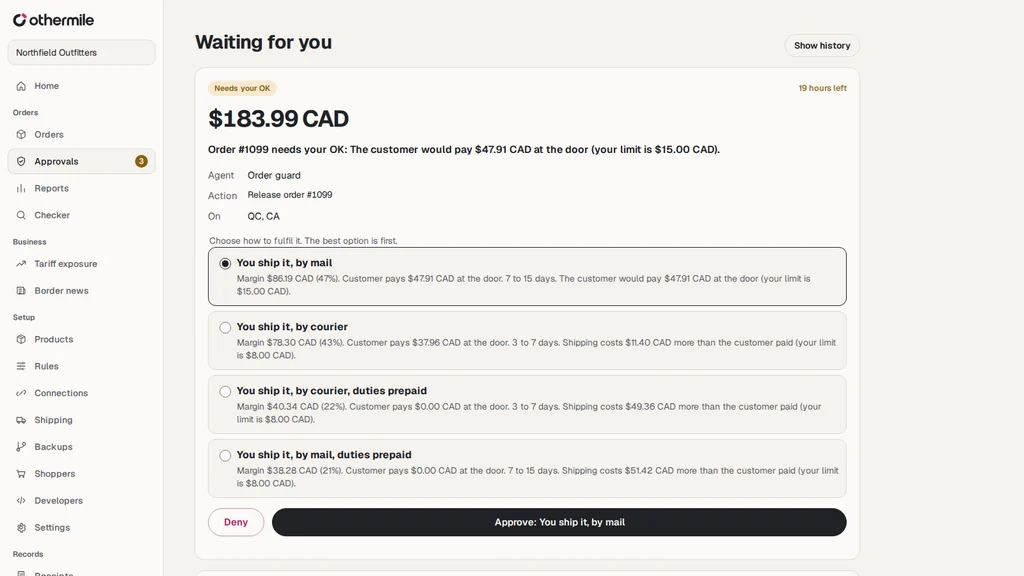
- Every order, before it ships: Othermile checks each one against your limits and holds the costly ones for your OK.
These are estimates from the official rules, not customs advice.
This guide explains public rules in plain language for general information. It is not customs, tax or legal advice; the exact tariff code, your paperwork and the carrier decide the final amount.
Selling on Shopify?
Othermile for Shopify
Check every Shopify order for Canada and US duties, tariffs and fees before it ships, hold the costly ones in Shopify, and show shoppers the cost at checkout.
Selling on WooCommerce?
Othermile for WooCommerce
A free plugin that checks every WooCommerce order for Canada and US duties, tariffs and fees, puts costly ones On hold, and shows shoppers the cost.
See what your own orders cost at the border.
Start freeOr try the free checker, or get an email when the rules change
Keep reading

Why did UPS or FedEx charge a fee on top of the duty?
Couriers charge their own fee for clearing a parcel through customs, separate from duty and tax. Here is what it is, why it can be bigger than the duty, and how stores avoid it.
Will my US customer pay duty on an order from my Canadian store?
Since August 2025 the US charges duty on small parcels too. Goods that qualify as made in North America can still enter free; others pay their duty and sometimes extra tariffs.

Do I pay duty on a parcel from the US to Canada?
Often no duty, but often tax. It depends on the value, on mail or courier, and on where the goods were made. Here are the limits and two worked examples.