How to price shipping to Canada without losing money
Five steps: know your real label cost, know the border cost, choose who pays it, set limits for the orders that do not fit, and review once a month.
By the Othermile team

Short answer: price Canadian shipping from three numbers, not one: what the label costs you, what your customer may pay at the door, and what you can absorb. Then decide who pays the border, you at checkout or your customer at the door, and set a limit for the orders that do not fit.
Step 1: know your real label cost
Look at your last 20 orders to Canada and note what each label really cost, by weight. Most stores find a spread: a light T shirt and a heavy hoodie can differ by several dollars. If you use one flat rate, it should cover your typical order, not your lightest.
Step 2: know the border cost for your typical order
For an order shipped from the US, the customer may owe sales tax (5% to 15%), duty on goods made outside North America above C$150, and the carrier's clearance fee. Our guide to mail or courier into Canada works through three real examples.
Step 3: choose who pays the border
| Option | What the customer sees | What you risk |
|---|---|---|
| Customer pays at the door | A cheaper checkout, then a bill on delivery | Refused parcels, complaints, lost repeat orders |
| You pay, priced into shipping | A higher shipping line, nothing at the door | Undercharging on some orders, overcharging on others |
| Duties included rate at checkout | The exact border cost for that cart, paid once | Almost nothing, once the amounts are right per cart |
Duties included rates per cart are the most accurate and the ones customers trust most, but they need each product's tariff code and origin. That is the job Othermile does at checkout on Shopify and WooCommerce.
Step 4: set limits for the orders that do not fit
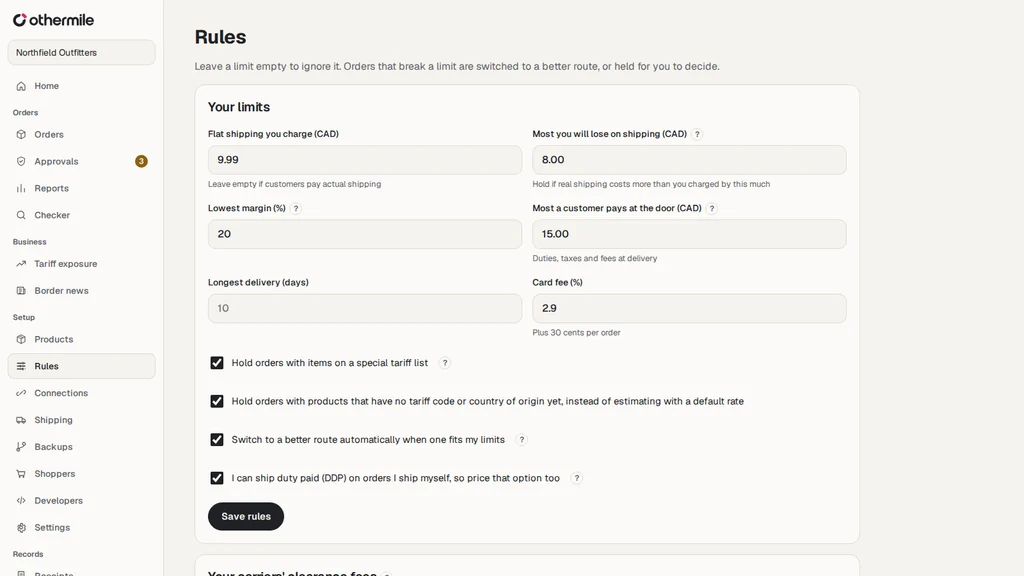
No flat price fits every order. Pick three numbers:
- The most a customer should pay at the door. Above it, the order is a likely refusal.
- The most you will lose on shipping. When the label costs more than you charged by this much, you want to know first.
- The lowest margin you accept. Below it, the order is not worth shipping as it is.
Orders inside the limits ship as usual. The rest are worth a look before they go: a cheaper carrier, a duty paid label or a note to the customer can save the order.
Step 5: review once a month
Rules change and carriers update their fees. Once a month, look at what your Canadian orders really cost you and adjust the rate.
Try it on your own parcel
What would this parcel owe at the border?
Change the product, where it was made, the price or how it ships, then check. Free, with no account.
Your estimate appears here.
Pick a product and price, then check.
Othermile checks every order like this before it ships, and holds the costly ones for your OK. Start free
Check your own numbers
- One parcel: the free border fee checker.
- Your store's last 90 days: the free border cost audit.
- Every order, before it ships: Othermile checks each one against your limits and holds the costly ones for your OK.
These are estimates from the official rules, not customs advice.
This guide explains public rules in plain language for general information. It is not customs, tax or legal advice; the exact tariff code, your paperwork and the carrier decide the final amount.
Selling on Shopify?
Othermile for Shopify
Check every Shopify order for Canada and US duties, tariffs and fees before it ships, hold the costly ones in Shopify, and show shoppers the cost at checkout.
Selling on WooCommerce?
Othermile for WooCommerce
A free plugin that checks every WooCommerce order for Canada and US duties, tariffs and fees, puts costly ones On hold, and shows shoppers the cost.
See what your own orders cost at the border.
Start freeOr price a parcel above, or get an email when the rules change
Keep reading

Selling on Whatnot between Canada and the US: who pays the border charges
When a Whatnot buyer is in the other country, the carrier bills them for duty, tax and fees on delivery. Who pays what on each route, with real numbers, and how to tell buyers before they bid.

Mail or courier into Canada: which costs your customer less?
Courier parcels from the US get higher tax free limits, but the clearance fee can tip it. Three worked examples at C$35, C$80 and C$200, and a rule of thumb.

The best tools to estimate Canada and US duties for online stores, compared honestly
Government lookups, Shopify, Managed Markets, Zonos, Avalara, shipping platforms and Othermile: what each does well, where each stops, and how to choose for orders between Canada and the US.